

Frozen Food Market Research Report Analysis by Product Type (Frozen Fruits, Frozen Vegetables, Dairy Products, Bakery Product, Frozen Meat, Frozen Seafood, Convenience Foods & Ready Meals, and Others), by Category (Raw Material, Half-Cooked, and Ready-To-Eat), by End User (Food Service and Retail), by Distribution Channel (Online and Offline) and by region (North America, Latin America, Europe, Asia Pacific, Middle East and Africa) Size, Share, Outlook, and Opportunity Analysis, 2024 – 2030
Pages: 122 | Dec-2023 Formats | PDF | Category: Food & Beverages | Delivery: 24 to 72 Hours
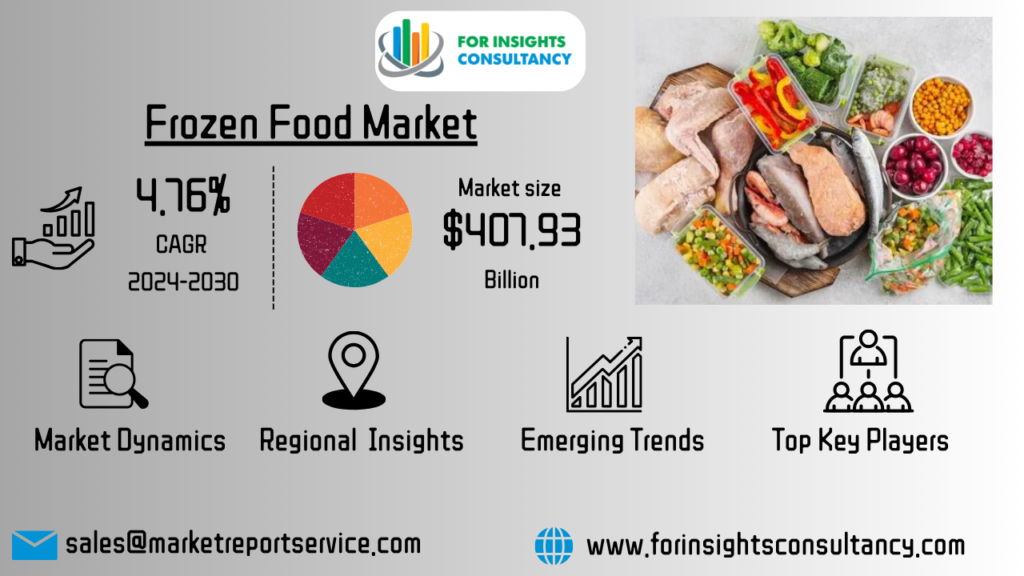
Frozen
Food Market is projected to grow from USD 294.87 Billion in 2024 to USD 407.93 Billion
by 2030, at a CAGR of 4.76%, driven by rising demand for convenience,
ready-to-eat meals, and frozen food innovations.
Frozen Food Market 2026: Overview and Growth in the Upcoming Year
The
worldwide frozen food market is expected to grow at a steady rate in 2026 due
to changes in consumer patterns, a spike in rates of urbanization, and an
increased demand for easily accessible food products. Focused on frozen food
products like ready to cook meals, snacks,
and desserts, as well as vegetables, fruits, meat, and seafood, there is an
increased demand for meals that are quick and convenient, as well as good for
you, and tastes great.
The
increased consumer focus on safety and hygiene in 2026, coupled with the
increased marketing of frozen food products, especially with the understanding
that freezing food maintains and preserves the food as well as extending the
life of the food, is expected to help increase sales of frozen foods worldwide.
The world
market for frozen foods is expected to grow from 294.87 Billion US Dollars in
2024 to 407.93 Billion US Dollars in 2030, with a CAGR or compounded annual
growth rate of 4.76%. Due to the vast increase in working populations and the
increase in disposable income to a point where consumers will outlay pocket
money for the use of time saving quick easy meals.
Market Dynamics 2026
Trends
Increased need for easy and
instant meal solutions
Especially
for urban and working families, the time and effort involved in cooking meals,
the demand for frozen foods has risen considerably.
Increase in health-focused frozen
food
Health-conscious
consumers continue steering the frozen foods category towards organics,
minimally processed, low-sodium, and preservative-free frozen food options.
Growth Drivers
Increasing demand for health-oriented and organic products
To support healthier diets,
consumers need frozen food products that are minimally processed, low in
sodium, and contain organic ingredients.
E-commerce and online grocery shopping
The proliferation of frozen food
products and their easy home delivery/buy online and pick up in store options
have led to greater sales and market penetration.
Opportunities
Expansion
of products that are organic and health-focused
Increasing demand for organic, low sodium,
preservative-free, and fortified frozen foods creates product development and
value added offers potential.
Innovation
of ethnic and gourmet frozen meals
New customers and market share can be gained by providing
international ready-to-cook gourmet meals and diverse ethnic products.
Challenges
Frozen foods and the consumer
attitude surrounding the topic
A portion
of consumers still view the nutrition and quality of frozen foods to be
inferior to that of fresh alternatives, which has resulted in a more limited
adoption in a number of markets.
Competitive market
There are
a large number of global and regional participants in the marketplace, so there
is a high degree of competition and a high number of frozen foods available to
consumers in the marketplace, leading to a high degree of marketplace
stagnation.
Disruptions in the supply chain
Frozen
food products are available to consumers in the marketplace in a limited way
due to global incidents, shortages of raw materials, and energy price
fluctuations.
Top Key Players Profiled in the Frozen Food Market
·
ConAgra Foods, Inc
·
General Mills, Inc.
·
H.J. Heinz Company
·
Tyson Foods
·
Unilever Plc
·
Maple Leaf Foods
·
Pinnacle Foods
Frozen Food Market company News
Maple Leaf Foods
Maple Leaf Foods has announced
its 2026 financial guidance, projecting mid-single-digit revenue growth partly
supported by sustained consumer demand in prepared and frozen food categories.
Nestlé
S.A.
Stouffer’s
began expanding into shelf-stable forms (Stouffer’s Supreme Shells &
Cheese) in late-2024; Nestlé’s frozen portfolio underperformed in North America
in 2024 per company reporting/industry press.
Ajinomoto
Co., Inc.
Corporate
portfolio change (2025) — announced sale of its entire equity stake in Ajinomoto
Althea (CDMO) — Apr 24, 2025 (not frozen-food core, but material to group
strategy).
Kraft
Foods Group
Frozen
product innovations (2025) — launched frozen-category innovations such as
no-thaw Lunchables PB&J (May 2025) and other product moves.
Major corporate
restructure announced (2025) — Kraft Heinz announced plans to split into two
companies (announced Sep 2, 2025) — material to strategy for frozen &
grocery brands (one new company will house many frozen/ready-to-eat / North
American grocery brands). (This is a big strategic item that affects frozen
portfolio positioning).
Segmentation Analysis
Segment
by Product type
Frozen Fruits & Vegetables: Includes frozen berries, peas,
corn, spinach, and mixed vegetables. These products retain high nutritional
value and cater to health-conscious consumers.
Frozen
Meat & Poultry: Covers
frozen chicken, beef, pork, and lamb. High demand from foodservice industries
drives this segment’s growth. Frozen Seafood: Includes shrimp, salmon, fish
fillets, and tuna. Rising seafood consumption and longer shelf life advantages
support this segment.
Frozen
Dairy Products: Comprising
ice cream, frozen yogurt, and cheese. The segment benefits from innovative
flavors and premium offerings.
Frozen
Bakery & Confectionery: Includes bread, pastries, cakes, and croissants. Growth is driven by
the increasing consumption of ready-to-bake products.
Frozen
Ready Meals:
Comprising frozen pizza, pasta, soups, and prepared entrees. Busy lifestyles
and increased demand for convenient meals propel this segment.
Segment
by Distribution Channel
Supermarkets
& Hypermarkets: Major
distribution points, offering a wide range of frozen food products.
Convenience
Stores: Ideal for
quick purchases, focusing on single-serving frozen foods.
Online
Retail & E-Commerce: Rapidly growing, driven by the rise of grocery delivery services
and subscription-based frozen food plans.
Specialty
Stores: Catering
to organic, plant-based, and health-focused frozen food products.
Key Market Segments: Frozen Food Market
Frozen
Food Market, by Product
- Ready
Meals
- Meat
& Poultry
- Seafood
- Dairy
Products
- Bakery
Products
- Bread
- Pizza
Crust
- Cakes
& Pastries
- Cookies
& Biscuits
- Doughnuts
- Waffles
- Other
Frozen Bakery Products
- Vegetables
- Fruits
- Other
Frozen Products
Frozen
Food Market, by Type
- Raw
- Half-cooked
- Ready-to-eat
Frozen Food Market Country-wise Insights
North America
With an
emphasis on busy schedules and meal prep ease, North America’s frozen food
industry will continue to prosper throughout 2026. North American consumer
trends showcase an interest in frozen products that are easy to prepare, ready
to serve, and healthier than traditional frozen meal options.
United States:
The U.S.
North American frozen food industry is the most profitabe. The U.S. has a fast
growing organic and health focused frozen food industry, a prepaired meal
market, and a growing population that pritorizes American urbanization. The
majority of American food patrons are influenced by Supermarket and online
grocery stores when it comes to organic and health focused frozen food
products.
Canada:
Canada is
seeing an increase in demand for frozen foods. This includes frozen fruits,
frozen vegetables, and prepaired frozen meals. In Canada there is an emphasis
on packaging that is safe, of high quality, and of high sustainability.
Mexico:
Consumer
safety and hygiene awareness is on the rise in Mexico’s urban centers and
mid-level classes. This has expanded the frozen food range available in Mexico.
Urbanization has changed the convenience food habits of the urbanized
middle-class population which has increased the demand for simple meal options,
and subsequently, prepacked meals.
Asia Pacific
The
Asia-Pacific frozen food market has strong growth potential for the following
reasons: steadily growing urbanization, rising disposable incomes, an increase
in the number of consumers utilizing the frozen food market, and further
development of eCommerce. While eCommerce and other retail platforms become
available, customers are utilizing ready-to-cook, ready-to-eat, and
health-conscious options available in the frozen food market. The Asia Pacific
frozen food market is expected to reach $XXX Billion.
China
Leading
the Asia-Pacific frozen food market is China. It houses the largest population
of the region. Additionally, China has a growing preference for convenient
frozen food options. The urban lifestyle provided by China’s growing middle-class
drives the demand for engaged and microwave-able frozen vegetable options.
India
The
frozen food industry remains at an emerging state, how ever, the markets of
most of India’s urban areas are steadily adopting frozen food options. The
expansion of India’s retail chains and cold-chain facilities, alongside rising
awareness for food safety, are all supports for the increase of food frozen
food options.
Japan
Despite
Japan’s Score (representing Japan’s Status as a frozen food industry), it has
reached all the levels of a frozen food industry. Vendors want to level up
their scored by providing even more premium and, in most case, health
conscious. Fresh frozen meal options, prepared meals, and frozen seafood are
all expected to meet this level.
Southeast Asia
As for
southeast asian markets, strong urbanization, growing disposable incomes, as
well as more retail options, Indonia, Thalia, Vietnam, Vietnam and the Phili
[[[is all providing extremely strong reasons for the frozen food markets.
Australia and New Zealand
The most
premium, and available frozen food options come from this market. The high
level sensitivity found in this market value is an extremely high demand to
provide. Food that is Organic, and has a focus on sustainability is in high
demand from consumers.
Europe
Europe’s
frozen food market is predicted to keep growing until 2026. In recent years,
the market has experienced a growing consumer demand for convenience.
Additionally, the market is shifting towards health-focused meals. Consumer
demand is growing towards meals that only need to be heated and those quick to
prepare and ready to be cooked.
Western Europe:
Germany,
the UK, and France have significant shares of the market. The market is
shifting towards the sales of organic and ready-to-cook meals, fillings, and
other frozen food. Customers appreciate the ease of use that self-service meals
provide, and this has encouraged supermarkets as well as e-commerce businesses
to expand their range of frozen meals.
Southern Europe:
Urban
customers from Spain, Italy, and Portugal have been the focus of the growing
demand for ready-to-eat frozen meals, frozen seafood, and frozen vegetables.
The demand has been the result of modern retail as well as the growing use of
the Internet, which has made the previously scarce products available.
Northern Europe:
In
Sweden, Denmark, and Finland the demand for frozen foods has been the focus of
the demand for sustainable and environmentally friendly foods. The demand by
organic and preservative-free food advocates has encouraged the production of
organic and preservative-free foods, which has encouraged the demand for the
production of such foods.
Eastern Europe:
Branding
frozen foods is a growing trend in Poland, Romania, and Hungary. The growing
interest of the urban population have brought about an increase in the demand
for convenience, safety, and nutritional food.
Middle East and Africa
The
frozen food market for the Middle East & Africa is predicted to gradually
increase by 2026, as urbanization, disposable income, and preference for ready
to eat meals and food driving the growth.
Middle East
The major
markets include Saudi Arabia, UAE, and Israel, with demand for ready to cook
meals, frozen seafood, and frozen vegetables. Urban lifestyle and income
increase lead to the acceptance of premium products.
North Africa
The urban
middle class of Egypt, Morocco, and Tunisia are growing and the rising food
safety, convenience, and hygiene are driving the growth of frozen food
products, ready meals and packaged vegetables.
Sub Saharan Africa
The
emerging markets for frozen foods are Nigeria, Kenya, and South Africa. There
is still a preference for fresh foods but as urbanization and retail
modernization increases there is a growing demand for frozen meals, frozen
meat, and packaged frozen veggies.
Southern Africa
Organized
retail and growing e-commerce in South Africa are driving the demand for
premium and convenient frozen food.
Frequently Asked Questions with Answers
What is
the Frozen Food market size and growth forecast?
Frozen
Food Industry Growth: The market is set to expand from USD 294.87B to USD
407.93B by 2030, at a CAGR of 4.76%, boosted by busy lifestyles, modern retail,
and increasing frozen food adoption globally.
Who are
the key players in the Frozen Food market?
The
Frozen Food Market Includes Major Companies Nestle S.A., Ajinomoto Co., Inc.,
Kraft Foods Group, Inc., ConAgra Foods, Inc., General Mills, Inc., H.J. Heinz
Company, Tyson Foods, Inc., Unilever Plc., Maple Leaf Foods, Inc., and Pinnacle
Foods, Inc, Others.
What are
the current and future trends for Frozen Food market?
Current
trend: Growing demand for healthy and organic frozen food options. Future
trend: Increased focus on convenient, plant-based and global cuisine frozen
food offerings.
What are
the challenges facing the Frozen Food market?
Challenges
facing the Frozen Food market include consumer perception of lower quality,
increasing demand for fresh foods, and competition from meal kit delivery
services.
Which
regions dominate the Frozen Food market?
North
America is the largest regional market for the frozen food market.
Key insights provided by the report that could help you take critical strategic decisions?
·
Regional
reports analyse product/service consumption and market factors in each region.
·
Reports
highlight possibilities and dangers for suppliers in the Frozen Food Market
business globally.
·
The
report identifies regions and sectors with the highest growth potential.
·
It
provides a competitive market ranking of major companies, as well as
information on new product launches, partnerships, business expansions, and
acquisitions.
·
The
report includes a comprehensive corporate profile with company overviews,
insights, product benchmarks, and SWOT analysis for key market participants.
Customization: We can provide following things
1) On
request more company profiles (competitors)
2) Data
about particular country or region
3) We
will incorporate the same with no additional cost (Post conducting
feasibility).
Any
Requirement Contact us: https://forinsightsconsultancy.com/contact-us/
Related Reports
Table of Content
- Introduction
1.1. Market Definition
1.2. Market Ecosystem
1.3. Currency
1.4. Key Stakeholders
- Research Methodology
2.1. Research Process
2.2. Data Collection & Validation
2.2.1. Secondary Research
2.2.2. Primary Research
2.3. Market Assessment
2.3.1. Market Size Estimation
2.3.1.1. Bottom-up Approach
2.3.1.2. Top-down Approach
2.3.1.3. Growth forecast
2.4. Assumptions for the Study
2.5. Limitations of the Study
- Executive Summary
3.1. Introduction
3.2. Segmental Analysis
3.2.1. Frozen Foods Market Analysis: by Product
3.2.2. Frozen Foods Market Analysis: by Type
3.2.3. Frozen Foods Market Analysis: by Distribution Channel
3.3. Regional Analysis
3.4. Key Players
- Market Insights
4.1. Introduction
4.2. Drivers
4.2.1. Increasing Demand for Convenience Foods
4.2.2. Growing Global Cold-chain Market
4.2.3. Consumers’ Changing Tastes & Preferences
4.3. Restraints
4.3.1. Rising Preference for Fresh & Natural Food Products
4.3.2. Constant Temperature Monitoring Requirements of Frozen Food Products
4.4. Opportunities
4.4.1. Increasing Digitalization In the Retail Industry
4.4.2. Emerging Economies in Asia-Pacific, Latin America, and the Middle East & Africa
4.5. Challenges
4.5.1. Lack of Cold-chain Infrastructure in Developing Countries
4.6. The Impact of COVID-19 on the Frozen Foods Market
- Global Frozen Foods Market, by Product
5.1. Introduction
5.2. Ready Meals
5.3. Meat & Poultry
5.4. Seafood
5.5. Dairy Products
5.6. Bakery Products
5.6.1. Breads
5.6.2. Pizza Crusts
5.6.3. Cakes & Pastries
5.6.4. Cookies & Biscuits
5.6.5. Doughnuts
5.6.6. Waffles
5.6.7. Other Frozen Bakery Products
5.7. Vegetables
5.8. Fruits
5.9. Other Frozen Food Products
- Global Frozen Foods Market, by Type
6.1. Introduction
6.2. Raw
6.3. Half-cooked
6.4. Ready-to-eat
- Global Frozen Foods Market, by Distribution Channel
7.1. Introduction
7.2. Business-to-Business (B2B)
7.2.1. Food Services
7.2.2. Food Manufacturers
7.2.3. Quick Service Restaurants (QSR’s)
7.3. Business-to-Consumer (B2C)
7.3.1. Offline
7.3.1.1. Supermarkets & Hypermarkets
7.3.1.2. Convenience Stores
7.3.1.3. Other Stores
7.3.2. Online
- Frozen Foods Market, by Geography
8.1. Introduction
8.2. Europe
8.2.1. Germany
8.2.2. U.K.
8.2.3. France
8.2.4. Italy
8.2.5. Spain
8.2.6. Rest of Europe (RoE)
8.3. North America
8.3.1. U.S.
8.3.2. Canada
8.4. Asia-Pacific
8.4.1. China
8.4.2. Japan
8.4.3. Australia
8.4.4. South Korea
8.4.5. India
8.4.6. Rest of Asia-Pacific (RoAPAC)
8.5. Latin America
8.5.1. Brazil
8.5.2. Mexico
8.5.3. Argentina
8.5.4. Rest of Latin America (RoLATAM)
8.6. Middle East & Africa
- Competitive Landscape
9.1. Introduction
9.2. Competitive Benchmarking
9.3. Market Share Analysis
- Company Profiles (Business Overview, Financial Overview, Product Portfolio, and Strategic Developments)
10.1. General Mills, Inc.
10.2. Conagra Brands, Inc.
10.3. Nestlé S.A.
10.4. Unilever PLC
10.5. Kellogg Company
10.6. Mccain Foods Limited
10.7. The Kraft Heinz Company
10.8. Tyson Foods, Inc.
10.9. Associated British Foods plc
10.10. Ajinomoto Co., Inc.
10.11. Vandemoortele NV
10.12. Lantmännen Unibake International (Part of Lantmännen Group)
10.13. Cargill, Incorporated
10.14. Europastry, S.A.
10.15. JBS S.A.
10.16. ARYZTA AG
10.17. Nomad Foods Limited
- Appendix
11.1. Questionnaire
11.2. Available Customization
List of Tables
Table 1 Global Frozen Foods Market: Impact Analysis of Market Drivers (2022–2030)
Table 2 Global Frozen Foods Market: Impact Analysis of Market Restraints (2022–2030)
Table 3 Global Frozen Foods Market Size, by Product, 2023-2030(USD Million)
Table 4 Global Frozen Ready Meals Market Size, by Country/Region, 2023-2030(USD Million)
Table 5 Global Frozen Meat & Poultry Market Size, by Country/Region, 2023-2030(USD Million)
Table 6 Global Frozen Seafood Market Size, by Country/Region, 2023-2030(USD Million)
Table 7 Global Frozen Dairy Products Market Size, by Country/Region, 2023-2030(USD Million)
Table 8 Global Frozen Bakery Products Market Size, by Type, 2023-2030(USD Million)
Table 9 Global Frozen Bakery Products Market Size, by Country/Region, 2023-2030(USD Million)
Table 10 Global Frozen Breads Market Size, by Country/Region, 2023-2030(USD Million)
Table 11 Global Frozen Pizza Crusts Market Size, by Country/Region, 2023-2030(USD Million)
Table 12 Global Frozen Cakes & Pastries Market Size, by Country/Region, 2023-2030(USD Million)
Table 13 Global Frozen Cookies & Biscuits Market Size, by Country/Region, 2023-2030(USD Million)
Table 14 Global Frozen Doughnuts Market Size, by Country/Region, 2023-2030(USD Million)
Table 15 Global Frozen Waffles Market Size, by Country/Region, 2023-2030(USD Million)
Table 16 Global Other Frozen Bakery Products Market Size, by Country/Region, 2023-2030(USD Million)
Table 17 Global Frozen Vegetables Market Size, by Country/Region, 2023-2030(USD Million)
Table 18 Global Frozen Fruits Market Size, by Country/Region, 2023-2030(USD Million)
Table 19 Global Other Frozen Food Products Market Size, by Country/Region, 2023-2030(USD Million)
Table 20 Global Frozen Foods Market Size, by Type, 2023-2030(USD Million)
Table 21 Global Frozen Foods Market Size for Raw Frozen Food, by Country/Region, 2023-2030(USD Million)
Table 22 Global Frozen Foods Market Size for Half-cooked Frozen Food, by Country/Region, 2023-2030(USD Million)
Table 23 Global Frozen Foods Market Size for Ready-to-eat Frozen Food, by Country/Region, 2023-2030(USD Million)
Table 24 Global Frozen Foods Market Size, by Distribution Channel, 2023-2030(USD Million)
Table 25 Global Frozen Foods Market Size for B2B Distribution Channel, by Type, 2023-2030(USD Million)
Table 26 Global B2B Frozen Foods Market Size, by Country/Region, 2023-2030(USD Million)
Table 27 Global Frozen Foods Market Size for Food Services, by Country/Region, 2023-2030(USD Million)
Table 28 Global Frozen Foods Market Size for Food Manufacturers, by Country/Region, 2023-2030(USD Million)
Table 29 Global Frozen Foods Market Size for Quick Service Restaurants, by Country/Region, 2023-2030(USD Million)
Table 30 Global Frozen Foods Market Size for B2C Distribution Channel, by Type, 2023-2030(USD Million)
Table 31 Global Frozen Foods Market Size for B2C Distribution Channel, by Country/Region, 2023-2030(USD Million)
Table 32 Global Frozen Foods Market Size for Offline Channel, by Type, 2023-2030(USD Million)
Table 33 Global Frozen Foods Market Size for Offline Channel, by Country/Region, 2023-2030(USD Million)
Table 34 Global Frozen Foods Market Size for Supermarkets & Hypermarkets, by Country/Region, 2023-2030(USD Million)
Table 35 Global Frozen Foods Market Size for Convenience Stores, by Country/Region, 2023-2030(USD Million)
Table 36 Global Frozen Foods Market Size for Other Stores, by Country/Region, 2023-2030(USD Million)
Table 37 Global Frozen Foods Market Size for Online Channel, by Country/Region, 2023-2030(USD Million)
Table 38 Frozen Foods Market Size, by Region, 2023-2030(USD Million)
Table 39 Europe: Frozen Foods Market Size, by Country/Region, 2023-2030(USD Million)
Table 40 Europe: Frozen Foods Market Size, by Product, 2023-2030(USD Million)
Table 41 Europe: Frozen Bakery Products Market Size, by Type, 2023-2030(USD Million)
Table 42 Europe: Frozen Foods Market Size, by Type, 2023-2030(USD Million)
Table 43 Europe: Frozen Foods Market Size, by Distribution Channel, 2023-2030(USD Million)
Table 44 Europe: B2B Frozen Foods Market Size, by Type, 2023-2030(USD Million)
Table 45 Europe: B2C Frozen Foods Market Size, by Type, 2023-2030(USD Million)
Table 46 Europe: B2C Frozen Foods Market Size for Offline Channel, by Type, 2023-2030(USD Million)
Table 47 Germany: Frozen Foods Market Size, by Product, 2023-2030(USD Million)
Table 48 Germany: Frozen Bakery Products Market Size, by Type, 2023-2030(USD Million)
Table 49 Germany: Frozen Foods Market Size, by Type, 2023-2030(USD Million)
Table 50 Germany: Frozen Foods Market Size, by Distribution Channel, 2023-2030(USD Million)
Table 51 Germany: B2B Frozen Foods Market Size, by Type, 2023-2030(USD Million)
Table 52 Germany: B2C Frozen Foods Market Size, by Type, 2023-2030(USD Million)
Table 53 Germany: B2C Frozen Foods Market Size for Offline Channel, by Type, 2023-2030(USD Million)
Table 54 U.K.: Frozen Foods Market Size, by Product, 2023-2030(USD Million)
Table 55 U.K.: Frozen Bakery Products Market Size, by Type, 2023-2030(USD Million)
Table 56 U.K.: Frozen Foods Market Size, by Type, 2023-2030(USD Million)
Table 57 U.K.: Frozen Foods Market Size, by Distribution Channel, 2023-2030(USD Million)
Table 58 U.K.: B2B Frozen Foods Market Size, by Type, 2023-2030(USD Million)
Table 59 U.K.: B2C Frozen Foods Market Size, by Type, 2023-2030(USD Million)
Table 60 U.K.: B2C Frozen Foods Market Size for Offline Channel, by Type, 2023-2030(USD Million)
Table 61 France: Frozen Foods Market Size, by Product, 2023-2030(USD Million)
Table 62 France: Frozen Bakery Products Market Size, by Type, 2023-2030(USD Million)
Table 63 France: Frozen Foods Market Size, by Type, 2023-2030(USD Million)
Table 64 France: Frozen Foods Market Size, by Distribution Channel, 2023-2030(USD Million)
Table 65 France: B2B Frozen Foods Market Size, by Type, 2023-2030(USD Million)
Table 66 France: B2C Frozen Foods Market Size, by Type, 2023-2030(USD Million)
Table 67 France: B2C Frozen Foods Market Size for Offline Channel, by Type, 2023-2030(USD Million)
Table 68 Italy: Frozen Foods Market Size, by Product, 2023-2030(USD Million)
Table 69 Italy: Frozen Bakery Products Market Size, by Type, 2023-2030(USD Million)
Table 70 Italy: Frozen Foods Market Size, by Type, 2023-2030(USD Million)
Table 71 Italy: Frozen Foods Market Size, by Distribution Channel, 2023-2030(USD Million)
Table 72 Italy: B2B Frozen Foods Market Size, by Type, 2023-2030(USD Million)
Table 73 Italy: B2C Frozen Foods Market Size, by Type, 2023-2030(USD Million)
Table 74 Italy: B2C Frozen Foods Market Size for Offline Channel, by Type, 2023-2030(USD Million)
Table 75 Spain: Frozen Foods Market Size, by Product, 2023-2030(USD Million)
Table 76 Spain: Frozen Bakery Products Market Size, by Type, 2023-2030(USD Million)
Table 77 Spain: Frozen Foods Market Size, by Type, 2023-2030(USD Million)
Table 78 Spain: Frozen Foods Market Size, by Distribution Channel, 2023-2030(USD Million)
Table 79 Spain: B2B Frozen Foods Market Size, by Type, 2023-2030(USD Million)
Table 80 Spain: B2C Frozen Foods Market Size, by Type, 2023-2030(USD Million)
Table 81 Spain: B2C Frozen Foods Market Size for Offline Channel, by Type, 2023-2030(USD Million)
Table 82 RoE: Frozen Foods Market Size, by Product, 2023-2030(USD Million)
Table 83 RoE: Frozen Bakery Products Market Size, by Type, 2023-2030(USD Million)
Table 84 RoE: Frozen Foods Market Size, by Type, 2023-2030(USD Million)
Table 85 RoE: Frozen Foods Market Size, by Distribution Channel, 2023-2030(USD Million)
Table 86 RoE: B2B Frozen Foods Market Size, by Type, 2023-2030(USD Million)
Table 87 RoE: B2C Frozen Foods Market Size, by Type, 2023-2030(USD Million)
Table 88 RoE: B2C Frozen Foods Market Size for Offline Channel, by Type, 2023-2030(USD Million)
Table 89 North America: Frozen Foods Market Size, by Country, 2023-2030(USD Million)
Table 90 North America: Frozen Foods Market Size, by Product, 2023-2030(USD Million)
Table 91 North America: Frozen Bakery Products Market Size, by Type, 2023-2030(USD Million)
Table 92 North America: Frozen Foods Market Size, by Type, 2023-2030(USD Million)
Table 93 North America: Frozen Foods Market Size, by Distribution Channel, 2023-2030(USD Million)
Table 94 North America: B2B Frozen Foods Market Size, by Type, 2023-2030(USD Million)
Table 95 North America: B2C Frozen Foods Market Size, by Type, 2023-2030(USD Million)
Table 96 North America: B2C Frozen Foods Market Size for Offline Channel, by Type, 2023-2030(USD Million)
Table 97 U.S.: Frozen Foods Market Size, by Product, 2023-2030(USD Million)
Table 98 U.S.: Frozen Bakery Products Market Size, by Type, 2023-2030(USD Million)
Table 99 U.S.: Frozen Foods Market Size, by Type, 2023-2030(USD Million)
Table 100 U.S.: Frozen Foods Market Size, by Distribution Channel, 2023-2030(USD Million)
Table 101 U.S.: B2B Frozen Foods Market Size, by Type, 2023-2030(USD Million)
Table 102 U.S.: B2C Frozen Foods Market Size, by Type, 2023-2030(USD Million)
Table 103 U.S.: B2C Frozen Foods Market Size for Offline Channel, by Type, 2023-2030(USD Million)
Table 104 Canada: Frozen Foods Market Size, by Product, 2023-2030(USD Million)
Table 105 Canada: Frozen Bakery Products Market Size, by Type, 2023-2030(USD Million)
Table 106 Canada: Frozen Foods Market Size, by Type, 2023-2030(USD Million)
Table 107 Canada: Frozen Foods Market Size, by Distribution Channel, 2023-2030(USD Million)
Table 108 Canada: B2B Frozen Foods Market Size, by Type, 2023-2030(USD Million)
Table 109 Canada: B2C Frozen Foods Market Size, by Type, 2023-2030(USD Million)
Table 110 Canada: B2C Frozen Foods Market Size for Offline Channel, by Type, 2023-2030(USD Million)
Table 111 Asia-Pacific: Frozen Foods Market Size, by Country/Region, 2023-2030(USD Million)
Table 112 Asia-Pacific: Frozen Foods Market Size, by Product, 2023-2030(USD Million)
Table 113 Asia-Pacific: Frozen Bakery Products Market Size, by Type, 2023-2030(USD Million)
Table 114 Asia-Pacific: Frozen Foods Market Size, by Type, 2023-2030(USD Million)
Table 115 Asia-Pacific: Frozen Foods Market Size, by Distribution Channel, 2023-2030(USD Million)
Table 116 Asia-Pacific: B2B Frozen Foods Market Size, by Type, 2023-2030(USD Million)
Table 117 Asia-Pacific: B2C Frozen Foods Market Size, by Type, 2023-2030(USD Million)
Table 118 Asia-Pacific: B2C Frozen Foods Market Size for Offline Channel, by Type, 2023-2030(USD Million)
Table 119 China: Frozen Foods Market Size, by Product, 2023-2030(USD Million)
Table 120 China: Frozen Bakery Products Market Size, by Type, 2023-2030(USD Million)
Table 121 China: Frozen Foods Market Size, by Type, 2023-2030(USD Million)
Table 122 China: Frozen Foods Market Size, by Distribution Channel, 2023-2030(USD Million)
Table 123 China: B2B Frozen Foods Market Size, by Type, 2023-2030(USD Million)
Table 124 China: B2C Frozen Foods Market Size, by Type, 2023-2030(USD Million)
Table 125 China: B2C Frozen Foods Market Size for Offline Channel, by Type, 2023-2030(USD Million)
Table 126 Japan: Frozen Foods Market Size, by Product, 2023-2030(USD Million)
Table 127 Japan: Frozen Bakery Products Market Size, by Type, 2023-2030(USD Million)
Table 128 Japan: Frozen Foods Market Size, by Type, 2023-2030(USD Million)
Table 129 Japan: Frozen Foods Market Size, by Distribution Channel, 2023-2030(USD Million)
Table 130 Japan: B2B Frozen Foods Market Size, by Type, 2023-2030(USD Million)
Table 131 Japan: B2C Frozen Foods Market Size, by Type, 2023-2030(USD Million)
Table 132 Japan: B2C Frozen Foods Market Size for Offline Channel, by Type, 2023-2030(USD Million)
Table 133 Australia: Frozen Foods Market Size, by Product, 2023-2030(USD Million)
Table 134 Australia: Frozen Bakery Products Market Size, by Type, 2023-2030(USD Million)
Table 135 Australia: Frozen Foods Market Size, by Type, 2023-2030(USD Million)
Table 136 Australia: Frozen Foods Market Size, by Distribution Channel, 2023-2030(USD Million)
Table 137 Australia: B2B Frozen Foods Market Size, by Type, 2023-2030(USD Million)
Table 138 Australia: B2C Frozen Foods Market Size, by Type, 2023-2030(USD Million)
Table 139 Australia: B2C Frozen Foods Market Size for Offline Channel, by Type, 2023-2030(USD Million)
Table 140 South Korea: Meat Production, 2017–2020 (KT)
Table 141 South Korea: Frozen Foods Market Size, by Product, 2023-2030(USD Million)
Table 142 South Korea: Frozen Bakery Products Market Size, by Type, 2023-2030(USD Million)
Table 143 South Korea: Frozen Foods Market Size, by Type, 2023-2030(USD Million)
Table 144 South Korea: Frozen Foods Market Size, by Distribution Channel, 2023-2030(USD Million)
Table 145 South Korea: B2B Frozen Foods Market Size, by Type, 2023-2030(USD Million)
Table 146 South Korea: B2C Frozen Foods Market Size, by Type, 2023-2030(USD Million)
Table 147 South Korea: B2C Frozen Foods Market Size for Offline Channel, by Type, 2023-2030(USD Million)
Table 148 India: Frozen Foods Market Size, by Product, 2023-2030(USD Million)
Table 149 India: Frozen Bakery Products Market Size, by Type, 2023-2030(USD Million)
Table 150 India: Frozen Foods Market Size, by Type, 2023-2030(USD Million)
Table 151 India: Frozen Foods Market Size, by Distribution Channel, 2023-2030(USD Million)
Table 152 India: B2B Frozen Foods Market Size, by Type, 2023-2030(USD Million)
Table 153 India: B2C Frozen Foods Market Size, by Type, 2023-2030(USD Million)
Table 154 India: B2C Frozen Foods Market Size for Offline Channel, by Type, 2023-2030(USD Million)
Table 155 RoAPAC: Frozen Foods Market Size, by Product, 2023-2030(USD Million)
Table 156 RoAPAC: Frozen Bakery Products Market Size, by Type, 2023-2030(USD Million)
Table 157 RoAPAC: Frozen Foods Market Size, by Type, 2023-2030(USD Million)
Table 158 RoAPAC: Frozen Foods Market Size, by Distribution Channel, 2023-2030(USD Million)
Table 159 RoAPAC: B2B Frozen Foods Market Size, by Type, 2023-2030(USD Million)
Table 160 RoAPAC: B2C Frozen Foods Market Size, by Type, 2023-2030(USD Million)
Table 161 RoAPAC: B2C Frozen Foods Market Size for Offline Channel, by Type, 2023-2030(USD Million)
Table 162 Latin America: Frozen Foods Market Size, by Country/Region, 2023-2030(USD Million)
Table 163 Latin America: Frozen Foods Market Size, by Product, 2023-2030(USD Million)
Table 164 Latin America: Frozen Bakery Products Market Size, by Type, 2023-2030(USD Million)
Table 165 Latin America: Frozen Foods Market Size, by Type, 2023-2030(USD Million)
Table 166 Latin America: Frozen Foods Market Size, by Distribution Channel, 2023-2030(USD Million)
Table 167 Latin America: B2B Frozen Foods Market Size, by Type, 2023-2030(USD Million)
Table 168 Latin America: B2C Frozen Foods Market Size, by Type, 2023-2030(USD Million)
Table 169 Latin America: B2C Frozen Foods Market Size for Offline Channel, by Type, 2023-2030(USD Million)
Table 170 Brazil: Frozen Foods Market Size, by Product, 2023-2030(USD Million)
Table 171 Brazil: Frozen Bakery Products Market Size, by Type, 2023-2030(USD Million)
Table 172 Brazil: Frozen Foods Market Size, by Type, 2023-2030(USD Million)
Table 173 Brazil: Frozen Foods Market Size, by Distribution Channel, 2023-2030(USD Million)
Table 174 Brazil: B2B Frozen Foods Market Size, by Type, 2023-2030(USD Million)
Table 175 Brazil: B2C Frozen Foods Market Size, by Type, 2023-2030(USD Million)
Table 176 Brazil: B2C Frozen Foods Market Size for Offline Channel, by Type, 2023-2030(USD Million)
Table 177 Mexico: Frozen Foods Market Size, by Product, 2023-2030(USD Million)
Table 178 Mexico: Frozen Bakery Products Market Size, by Type, 2023-2030(USD Million)
Table 179 Mexico: Frozen Foods Market Size, by Type, 2023-2030(USD Million)
Table 180 Mexico: Frozen Foods Market Size, by Distribution Channel, 2023-2030(USD Million)
Table 181 Mexico: B2B Frozen Foods Market Size, by Type, 2023-2030(USD Million)
Table 182 Mexico: B2C Frozen Foods Market Size, by Type, 2023-2030(USD Million)
Table 183 Mexico: B2C Frozen Foods Market Size for Offline Channel, by Type, 2023-2030(USD Million)
Table 184 Argentina: Frozen Foods Market Size, by Product, 2023-2030(USD Million)
Table 185 Argentina: Frozen Bakery Products Market Size, by Type, 2023-2030(USD Million)
Table 186 Argentina: Frozen Foods Market Size, by Type, 2023-2030(USD Million)
Table 187 Argentina: Frozen Foods Market Size, by Distribution Channel, 2023-2030(USD Million)
Table 188 Argentina: B2B Frozen Foods Market Size, by Type, 2023-2030(USD Million)
Table 189 Argentina: B2C Frozen Foods Market Size, by Type, 2023-2030(USD Million)
Table 190 Argentina: B2C Frozen Foods Market Size for Offline Channel, by Type, 2023-2030(USD Million)
Table 191 RoLATAM: Frozen Foods Market Size, by Product, 2023-2030(USD Million)
Table 192 RoLATAM: Frozen Bakery Products Market Size, by Type, 2023-2030(USD Million)
Table 193 RoLATAM: Frozen Foods Market Size, by Type, 2023-2030(USD Million)
Table 194 RoLATAM: Frozen Foods Market Size, by Distribution Channel, 2023-2030(USD Million)
Table 195 RoLATAM: B2B Frozen Foods Market Size, by Type, 2023-2030(USD Million)
Table 196 RoLATAM: B2C Frozen Foods Market Size, by Type, 2023-2030(USD Million)
Table 197 RoLATAM: B2C Frozen Foods Market Size for Offline Channel, by Type, 2023-2030(USD Million)
Table 198 Middle East & Africa: Frozen Foods Market Size, by Product, 2023-2030(USD Million)
Table 199 Middle East & Africa: Frozen Bakery Products Market Size, by Type, 2023-2030(USD Million)
Table 200 Middle East & Africa: Frozen Foods Market Size, by Type, 2023-2030(USD Million)
Table 201 Middle East & Africa: Frozen Foods Market Size, by Distribution Channel, 2023-2030(USD Million)
Table 202 Middle East & Africa: B2B Frozen Foods Market Size, by Type, 2023-2030(USD Million)
Table 203 Middle East & Africa: B2C Frozen Foods Market Size, by Type, 2023-2030(USD Million)
Table 204 Middle East & Africa: B2C Frozen Foods Market Size for Offline Channel, by Type, 2023-2030(USD Million)
Table 205 Number of Developments by Major Players During 2023
List of Figures
Figure 1 Key Stakeholders
Figure 2 Research Process
Figure 3 Key Secondary Sources
Figure 4 Primary Research Techniques
Figure 5 Key Executives Interviewed
Figure 6 Breakdown of Primary Interviews (Supply-side & Demand-side)
Figure 7 Market Size Estimation
Figure 8 Ready Meals to be the Largest Segment
Figure 9 Raw to Remain the Largest Segment Through 2030
Figure 10 The Business-to-Business (B2B) Segment is Expected to Dominate the Global Market
Figure 11 Asia-Pacific to be the Fastest-Growing Regional Market
Figure 12 Market Dynamics
Figure 13 The U.S.: Annual Retail Sales, 2013–2020 (USD Million)
Figure 14 Global Frozen Foods Market Size, by Product, 2023-2030 (USD Million)
Figure 15 Global Frozen Bakery Products Market Size, by Type, 2023-2030 (USD Million)
Figure 16 Global Frozen Foods Market Size, by Type, 2023-2030 (USD Million)
Figure 17 Global Frozen Foods Market Size, by Distribution Channel, 2023-2030 (USD Million)
Figure 18 Global Frozen Foods Market Size for B2B Distribution Channel, by Type, 2023-2030 (USD Million)
Figure 19 Global Frozen Foods Market Size for B2C Distribution Channel, by Type, 2023-2030 (USD Million)
Figure 20 Global Frozen Foods Market Size for Offline Channel, by Type, 2023-2030 (USD Million)
Figure 21 Frozen Foods Market Size, by Region, 2023-2030 (USD Million)
Figure 22 Europe: Frozen Foods Market Snapshot (2022)
Figure 23 North America: Frozen Foods Market Snapshot (2022)
Figure 24 U.S.: Frozen Foods Sales, 2016-2020 (Usd Billion)
Figure 25 Asia-Pacific: Frozen Foods Market Snapshot (2022)
Figure 26 Latin America: Frozen Foods Market Snapshot (2022)
Figure 27 Middle East & Africa: Frozen Foods Market Snapshot (2022)
Figure 28 Key Growth Strategies Adopted by Leading Players, 2023
Figure 29 Frozen Foods Market: Competitive Benchmarking, by Product
Figure 30 Global Frozen Foods Market Share, by Key Player, 2022
Figure 31 General Mills, Inc.: Financial Overview (2022)
Figure 32 Conagra Brands, Inc.: Financial Overview (2022)
Figure 33 Nestlé S.A.: Financial Overview (2022)
Figure 34 Unilever PLC: Financial Overview (2022)
Figure 35 Kellogg Company: Financial Overview (2022)
Figure 36 The Kraft Heinz Company: Financial Overview (2022)
Figure 37 Tyson Foods, Inc.: Financial Overview (2022)
Figure 38 Associated British Foods plc: Financial Overview (2022)
Figure 39 Ajinomoto Co., Inc.: Financial Overview (2022)
Figure 40 Vandemoortele NV: Financial Overview (2022)
Figure 41 Lantmännen Group: Financial Overview (2022)
Figure 42 Cargill, Incorporated: Financial Overview (2022)
Figure 43 Europastry, S.A.: Financial Overview (2020)
Figure 44 JBS S.A.: Financial Overview (2022)
Figure 45 ARYZTA AG: Financial Overview (2022)
Figure 46 Nomad Foods Limited: Financial Overview (2022)
Select PDF License
Single User: $3499
Multiple Users: $4499
Corporate Users: $5499