

Frozen Fruits Market Report 2026–2034: Smoothie & Snacking Culture Fuel Growth
21 September-2026 Formats | PDF | Category: Food & Beverages | Delivery: 24 to 72 Hours
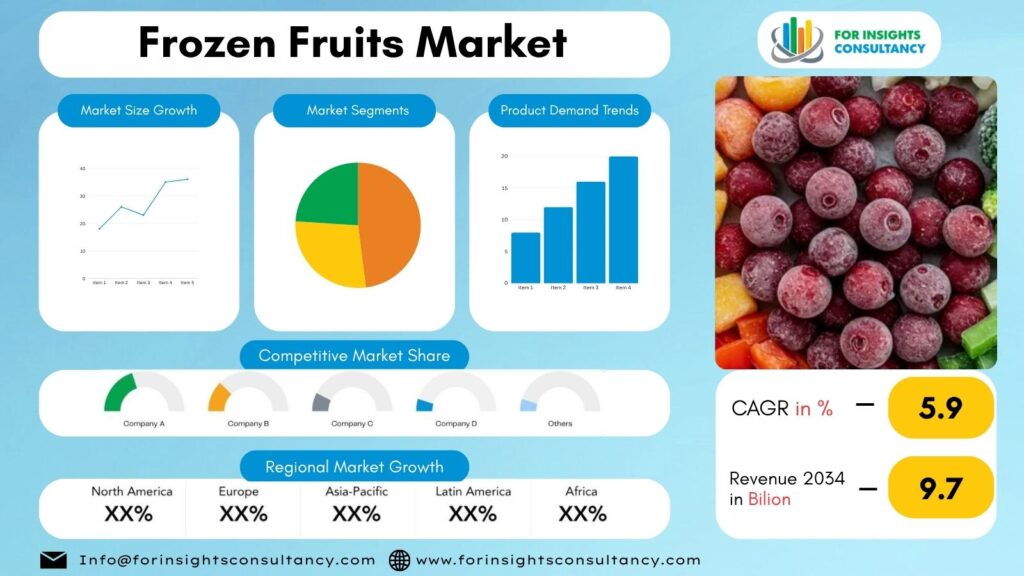
Frozen Fruits Market Growth Outlook
- Market Size (2026): ~$6.15 Billion
- Forecast (2034): ~$9.7 Billion
- CAGR (2026–2034): 5.9%
- Base Year: 2025 ~$5.8 Billion
- Leading Segment (2026): Tropical Fruits (Papaya, Pineapple, Mango, Banana) — ~38% share, ahead of Berries and Citrus; Berries remain the fastest-growing sub-segment.
- Top Region (2026): Europe — ~35–37% share, ahead of North America.
- Market Trends: Frozen fruit is shifting from a seasonal produce substitute into a core food-manufacturing ingredient, increasingly built into smoothies, yogurts, and bakery products rather than sold mainly as a frozen stand-in for fresh fruit.
Frozen Fruits Market Briefing
Frozen fruits are fruits that have been instantly frozen right after harvesting to retain their nutrition, flavor, and texture. They provide a longer shelf life compared to fresh fruits but are still available all-year-round irrespective of the harvest season. The global market for frozen fruits has been valued at about $6.15 billion in 2026, from a base of around $5.8 billion in 2025, and is expected to rise to about $9.7 billion by 2034, expanding at a CAGR of around 5.9%.
The market growth will be supported by increasing health awareness among consumers, rising demand for convenience of consumption of smoothies, desserts, bakery products, and beverages, as well as increased awareness of consumers regarding the feasibility of using frozen fruits as an alternate to fresh fruits.
The largest share in the market belongs to tropical fruits like papayas, pineapples, mangoes, and bananas, with berries (raspberries, blueberries, and strawberries) making up the fastest-growing portion of the market, thanks to increasing use in drinks and functional foods. Regionally, Europe dominates the market, benefiting from high consumption in Belgium, the Netherlands, Germany, and Scandinavia, combined with a thriving smoothie culture, whereas North America and an increasingly fast-growing Asia-Pacific region will continue to increase their market shares thanks to increased demand in such countries as China, India, and Japan.
In the future, it is expected that the market will grow steadily until 2034 due to further improvements in the field of rapid freezing and cold chain technology, increased e-commerce sales, and increased usage of frozen fruits as a basic ingredient in food processing rather than just a frozen alternative for fresh products.
Request a Free Sample Copy: https://www.forinsightsconsultancy.com/reports/request-sample-frozen-fruits-market
Frozen Fruits Market Growth Driver 2026
Greater Usage in Food Processing and Manufacturing Industry
The use of frozen fruit in secondary food and beverages produced by food manufacturing companies has become greater, including products made from dairy, baked foods, and drinks. This has been due to the higher degree of consistency that frozen fruit offers when compared to fresh produce, whose specifications may vary with season and region.
Advances in Freezing and Refrigeration Technologies
Improved technologies in freezing techniques and logistics have contributed to higher efficiency in preservation of product texture and nutrition after the thawing procedure. These changes have been applicable to fruits traditionally vulnerable to lower quality when frozen using older techniques.
Online and Delivery Purchasing of Frozen Foods
Consumer shopping habits for frozen foods have revealed a higher tendency towards online and delivery purchases, which corresponds to wider trends among consumers buying packaged foods in general.
Decreased Food Wastage by Households
Longer shelf life offered by frozen fruit compared to fresh produce has been identified as one of the factors responsible for the decrease in household wastage of food, which is in line with the food waste reduction policies in some countries.
Increased Demand from the Beverage and Foodservice Sectors
Food producers and the food service industry have increasingly depended upon frozen fruit products due to their necessity for ensuring consistent availability that is not dependent on seasonal availability from agriculture.
Trends 2026
Use of Frozen Fruit as an Input in Manufacturing
The use of frozen fruit as an input in manufacturing secondary food and beverage products such as smoothies, yogurts, frozen deserts, cereals, and bakery products as opposed to being used primarily as a retail alternative to fresh fruit has been on the rise, reflecting a trend toward demand from manufacturing in the industry as opposed to primarily retail consumer demand.
Advancement in Freezing and Cold Chain Technology
Further developments in rapid freezing technology and improvements in the cold chain logistics technology have helped enhance the preservation of texture, taste, and nutritional value of frozen fruits after freeze and thaw processes. This addresses issues that were previously associated with frozen fruits from some varieties of fruits.
Distribution of Frozen Fruit through Online/Digital Retail Channels
The distribution of frozen fruit through online/digital retail channels has risen, as has been the case with other packaged/frozen foods.
Differentiating Growth Based on Types of Fruits
In the segment, there are differences in terms of growth depending on the type of fruits produced. The tropical fruits (which include the papaya, pineapple, mango, and bananas) presently dominate the segment in terms of value production, whereas the berry fruits (which include strawberries, blueberries, and raspberries) have been noted as the fastest growing sub-segment, linked partly to their usage in beverages.
Regional Differences Between Market Size and Growth
The available data shows that Europe presently constitutes the largest market in terms of value, although the Asia-Pacific region is noted as having a relatively faster growth rate. It is important to note these two measures independently when considering regional market dynamics, since the larger market currently may not necessarily be the fastest growing market.
Top Companies Covered
- Dole Food Company, Inc.
- Ardo Group (Belgium)
- Conagra Brands, Inc.
- SunOpta Inc.
- Wawona Frozen Foods
- Simplot (J.R. Simplot Company)
- Crop’s nv (Belgium)
- Nomad Foods Limited
- Nature’s Touch Frozen Foods, LLC
- General Mills, Inc. (via Yoplait)
- Titan Frozen Fruit, LLC
- Fresh Del Monte Produce, Inc.
- MIRELITE MIRSA
Frozen Fruits Market Company news 2026
Nomad Foods Limited
Europe’s leading frozen food company (Birds Eye, Iglo, Findus brands) is in an active growth phase — the company entered exclusive negotiations to purchase Fortenova Group’s Frozen Food Business Group (FFBG), based in Zagreb, Croatia, a notable European M&A move expanding its regional footprint. Separately, CEO Dominic Brisby and CFO Ruben Baldew presented at the Barclays 19th Annual Global Consumer Staples Conference in Boston, September 8–10, 2026, giving investors visibility into the company’s strategy. As of July 2026, Nomad Foods carries a market cap of roughly $1.81 billion, with analysts issuing a “Strong Buy” rating and a price target of $24.04, though the company’s growth drivers (product innovation, premiumization, e-commerce) are weighed against risks from competitive retail markets and supply chain disruption.
SunOpta Inc.
A mixed operational year — SunOpta shut down its frozen fruit processing plant in Santa Maria, California, effective February 1, 2026, a notable capacity consolidation move. This follows SunOpta’s earlier strategic bet on the category via its $450 million acquisition of Sunrise Growers (historical context, not 2026-dated, but relevant background), which the company described as “transformative” for expanding its scale in the high-growth private-label frozen fruit segment.
Frozen Fruits Market Segments
In Terms of Fruit Type
Berries are dominant as their nutrition content is higher while they have a vast application in beverages, dessert, and bakery products. Tropical fruits and citrus fruits make two other main segments, while stone fruits are part of other types.
In Terms of Product Form
The largest share is of whole frozen fruits while other forms include sliced, diced, pureed, and mixed fruits.
In Terms of Processing Technology
Individual Quick Freezing (IQF) technology is most widely used as it retains the texture and allows easy distribution in portions, while freeze drying is applied only to some niche products.
In Terms of Application
It is mainly applied in dairy and desserts, smoothies and beverages, bakery and confectionery, and jams and preserves applications.
In Terms of Distribution Channel
The largest share belongs to supermarkets and hypermarkets owing to their availability while the fastest-growing one is online retail.
Frozen Fruits Market Regional Insights
Europe
Market Share (2026): (~36% share, market leader)
Major Players: Ardo, Crop’s NV, AGRANA Beteiligungs-AG, Greenyard, Bonduelle, Nomad Foods, MIRELITE MIRSA.
Consumer Trends: Preferably consume organic and sustainably produced frozen berries; highly involved in the production of desserts, bakery items, and breakfast foods; increasing trend towards the consumption of clean-label products with limited ingredients.
North America
Market Share (2026): (~34% share, close second)
Top Companies: Dole plc, SunOpta Inc., Conagra Brands, Simplot, Wawona Frozen Foods, Taylor Farms, Titan Frozen Fruit
Consumer Trends 2026: The use case of smoothie drinks and beverages remains the top one, whereas the increased preference for plant-based/vegan diets is making frozen fruits increasingly popular as an alternative to dairy and desserts; high demand for convenient “grab-and-blend” servings due to their convenience.
Asia-Pacific
Market Share (2026): (~20% share, fastest-growing)
Leading Companies: Capricorn Food Products India Ltd., alongside domestic Chinese processors such as Santao and Gaotai serving regional supply chains
Consumer Trends 2026: First-time adoption of frozen fruits as a convenience item in China and India is being fuelled by rapid urbanization and increasing income levels of the middle class; growth will take place mainly through retail formats that have cold chain distribution (supermarkets, e-commerce).
Middle East & Africa — Smallest, Early-Stage Region
Market Share (2026): (~4% share, smallest)
Leading Brands: Similarly, no distinct regional brand names surfaced in available research — this remains the least brand-consolidated region, likely served through import/distribution arrangements with global players rather than local manufacturers.
Trends Among Consumers: The growth phase of the industry is at an early stage of development and closely linked with the development of supermarkets. The shift in consumer trends has not yet been identified.
Latin America
Market Share (2026): (~6% share)
Main Products: No single regional brand dominates the way it does in Europe or North America — the market here is served more by local/regional processors and export operations of global majors (Dole, Nestlé) than by distinct homegrown frozen-fruit brands, based on what’s available in current market research.
Customer Trends 2026: Gradual adoption linked to development of retailing in the modern era, especially in countries like Brazil and Mexico, due to the use of frozen forms, which increases the shelf life of fruit.
Frequently Asked Questions
What is the size of the frozen fruits market?
The global frozen fruits market revenue is estimated at USD 6.15 billion in 2026 and is projected to rise to USD 9.7 billion by 2034, reflecting a CAGR of 5.9% during the 2026–2034 forecast period.
Which fruit type leads the frozen fruits market?
Berries lead the frozen fruits market, driven by strong demand across smoothies, desserts, and bakery applications.
What is driving growth in the frozen fruits market?
The main factors responsible for this include increased health awareness, popularity of veganism and plant-based diets, and increased demand for easy-to-consume, shelf-stable fruits for use in shakes and desserts.
Which region leads the frozen fruits market?
Europe accounts for the largest market share of around 36%, followed by North America with 34%, while Asia-Pacific is the most rapidly growing region.
Who are the key players in the frozen fruits market?
Major players in this industry include Dole plc, Nestlé S.A., Ardo, SunOpta Inc., Greenyard, Conagra Brands, Nomad Foods Limited, and Fresh Del Monte Produce, in a fairly fragmented industry environment.
What is the fastest-growing distribution channel for frozen fruits?
Online shopping is the fastest-growing form of retailing, despite the fact that the greatest share of sales is done by supermarkets and hypermarkets.
What’s Included in This Report — Frozen Fruits Market
Market Size & Forecast
Historical data (2020–2025) and forecast values (2026–2034), with market revenue estimated at USD 6.15 billion in 2026 growing to USD 9.7 billion by 2034 at a CAGR of 5.9%.
Segmentation Analysis
Detailed breakdowns by Fruit Type (berries, tropical, citrus, stone fruits, others), Product Form (whole, sliced, diced, purees, blended mixes), Application (smoothies & beverages, bakery & confectionery, dairy & desserts, jams & preserves, foodservice), and Distribution Channel (supermarkets & hypermarkets, convenience stores, online retail).
Regional & Country-Level Insights
Market share and growth analysis across North America, Europe, Asia-Pacific, Latin America, and Middle East & Africa, with country-level detail for key markets including the U.S., Germany, China, India, and Brazil.
Competitive Landscape
Company profiles, market positioning, and strategic overview of leading players including Dole plc, Nestlé S.A., Ardo, SunOpta Inc., Greenyard, Conagra Brands, Nomad Foods Limited, and Fresh Del Monte Produce.
Market Dynamics
Analysis of key growth drivers, restraints, opportunities, and emerging trends shaping the market through 2034.
Consumer & Industry Trends
Coverage of health-and-wellness demand, plant-based diet adoption, e-commerce channel growth, and premium/organic product trends.
Customization Options
Ability to request additional country-level breakdowns, company profiles, or a narrower/broader market scope tailored to specific research needs.
Who Should Buy This Report?
Frozen Fruit Manufacturers & Processors
Benchmark your market position, identify white-space opportunities by fruit type or region, and validate expansion plans against current segment growth rates.
Food & Beverage Companies
Bakery, dairy, smoothie, and confectionery brands sourcing frozen fruit as an ingredient can use this data to anticipate input-cost trends and identify emerging application categories.
Distributors & Retailers
Supermarket chains, online grocery platforms, and specialty frozen food retailers looking to optimize category mix and channel strategy based on regional demand patterns.
Investors & Private Equity Firms
Evaluate market attractiveness, growth trajectory, and competitive concentration before funding or acquiring frozen food assets.
New Market Entrants & Startups
Understand competitive intensity, regional entry points, and underserved segments (such as Latin America and Middle East & Africa) before committing capital.
Trade Associations & Policy Researchers
Reference regional and segment-level data for industry reporting, trade policy analysis, or agricultural planning.
Buy This Report Now — https://www.forinsightsconsultancy.com/buy-now-frozen-fruits-market/ (Access In-Depth Analysis, Forecasts & Company Profiles)
Related Market Reports of Food Industry
Frozen Bakery Market Size, Share & Growth Forecast 2034
Frozen Food Market Size & Forecast to 2034
Frozen Drinks Market Size, Trends 2026
Kiwi Fruit Market Size, Share & Forecast 2034
Dairy Products Market Report 2026–2034
For TOC Contact us: https://forinsightsconsultancy.com/contact-us/
Select PDF License
Single User: $3499
Multiple Users: $4499
Corporate Users: $5499