

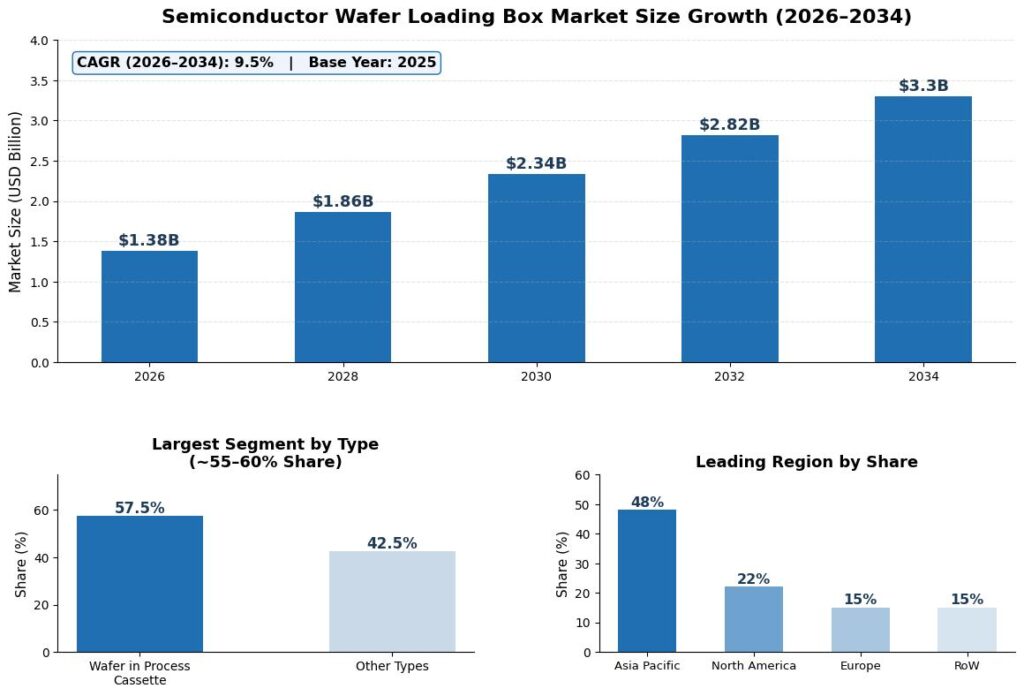
Semiconductor Wafer Loading Box Market Size
- Market Size (2026): USD 1.38 Billion
- Forecast (2034): USD 3.3 Billion
- CAGR (2026–2034): 9.5%
- Base Year: 2025
- Largest Segment: Wafer in Process Cassette dominates the market by type, accounting for the largest share (~55–60%)
- Leading Region: Asia Pacific (~48% Share)
Semiconductor Wafer Loading Box MarketExecutive Summary
The Semiconductor Wafer Loading Box Market Value is estimated to be USD 1.38 Billion in 2026, reaching USD 3.3 Billion by 2034, growing at a CAGR of 9.5% since the 2025’s base year. Rising semiconductor fabrication capabilities and adoption 300 mm wafer manufacturing processes, alongside contamination control rules, are expected to propel the semiconductor wafer loading box industry’s growth. From the segmentation point of view, the Wafer in Process Cassettes is the largest category, accounting for the majority of 55 – 60%, driven by continuous transfers of wafers between in-fab manufacturing processes. Regionally, the Asia Pacific accounts for the largest share of the semiconductor wafer loading box market in 2025, representing around 48% on a regional level due to high semiconductor manufacturing concentration in Taiwan, South Korea, China, and Japan.
Semiconductor Wafer Loading Box Market Overview
A Semiconductor Wafer Loading Box (also known as a wafer cassette or wafer carrier) is a specialized container used for storage, transportation, and protection of silicon wafers. Due to the fragile nature of wafers, appropriate handling and storage conditions are critical. This type of container is used both within the factory (to transfer wafers from one processing stage to another: etching, deposition, lithography) and outside the factory (distribution of wafers between manufacturers).
Why these factors are driving the market
Fab capacity expansion: Every new fab under the US CHIPS Act, EU Chips Act and the investment programs across Asia-Pacific requires wafer handling infrastructure right from the beginning, and thus fab construction directly equals the demand for loading boxes.
Adoption of 300mm wafers: Wafers of larger diameters tend to cause warping during transport and are heavier. This necessitates the replacement of simple cassettes with more robust and heavier boxes during fab upgrade, resulting in increased volumes as well as ASP.
Reduction in node size: With the reduction in node size below 7nm, a single particle on the wafer can damage the microstructure of the chip, necessitating more frequent replacement of cassettes with boxes that have been tested to be free of particulate emissions. This leads to higher volumes and ASP.
Adoption of automation (AMHS): Automated manufacturing handling systems require cassettes and boxes that are compatible with automation systems. This necessitates hardware upgrades for existing fabs during upgrades that are required for newer nodes.
Demand for chips from end markets (AI, automotive, 5G): Demand for chips from these markets will drive demand for wafers, which in turn will drive demand for loading boxes.
Future Analysis (2026-2034)
The market is projected to grow at a CAGR of 9.5%, rising from USD 1.38 Billion in 2026 to USD 3.3 Billion by 2034. The key trends are highlighted below:
Wafer In Process Cassette demand is projected to maintain its dominant position (accounting for ~55-60% of the overall market): With the increase in fab throughput, the internal cycle rate will outpace the external shipping volume.
The Asia-Pacific region is anticipated to maintain its lead (~48% overall market share): However, North America’s growth rate is likely to accelerate due to the ramp-up of CHIPS Act-related fabs (Intel, TSMC Arizona, Samsung Texas) towards the latter half of the forecast period.
Material innovation will be a key differentiator: Transition to advanced antistatic polymers and hybrid composite materials is likely for leading-edge manufacturing needs (sub-5nm and sub-3nm nodes).
Consolidation is expected within the industry: A small set of established players (Entegris, Shin-Etsu Polymer, Miraial, Gudeng Precision) are well-positioned to benefit from high manufacturing specialization and integration, which will limit new entrants, and drive M&A activity.
Market Dynamics 2026
Trends
Shift Toward Advanced Contamination Control
With nodes below 7nm, fabs are turning towards ultra-clean, anti-static cassette designs to prevent even the tiniest particle risks – driving the market towards higher value, premium loading boxes over standard variants.
Automation-Compatible Cassette Design
The rising adoption of Automated Material Handling Systems (AMHS) in fabs is spurring demand for cassettes designed to strict sensor- and robotics-friendly specifications replacing manually-handled variants.
Regional Manufacturing Diversification
While Asia-Pacific continues to dominate, CHIPS Act and EU Chips Act driven fab constructions in the U.S. and Europe are creating new regional demand pockets, prompting box makers to expand distribution closer to new fabs.
AI & High-Performance Computing Demand Spillover
The soaring demand for AI accelerators and HPC chips is causing increased utilization rates of fabs, which directly drives wafer cycling volumes and by extension, loading box consumption.
Consolidation Among Established Players
High precision-manufacturing hurdles are limiting new entrants – expect continued M&A and expansion by incumbents (Entegris, Shin-Etsu Polymer, Miraial, Gudeng Precision) rather than fragmentation.
Top Companies Covered In This Report
- Entegris
- Shin-Etsu Polymer
- Miraial
- Chuang King Enterprise
- Gudeng Precision
- ePAK
- 3S Korea
- Dainichi Shoji
Semiconductor Wafer Loading Box Industry Company News
Entegris
Entegris reshored production of its front-opening unified pods — used by Intel, TSMC, and other major chipmakers to secure wafers during processing — to a new Colorado Springs manufacturing facility, marking a shift back to domestic manufacturing after decades of offshore production. The 135,000-square-foot facility has created several hundred jobs and received close to $100 million in combined local and federal incentives. Separately, Entegris also entered a partnership with 3S Korea to supply 450mm wafer handling products — including FOUPs, Multi Application Carriers, and Single Wafer Shippers — to customers in Korea. On the financial side, Citi maintained a Buy rating on Entegris with a $100 price target, citing improving wafer starts and a more favorable outlook for 2026.
Gudeng Precision
Gudeng had a strong 2026, driven largely by advanced-node and EUV-related demand. The company posted record June revenue and its strongest quarterly sales in Q2 2026, driven by rising demand for EUV mask carriers and 12-inch wafer carriers as advanced-node manufacturing accelerated. It followed this with record revenue for the first seven months of 2026, supported by stronger EUV pod orders and increased purchases from overseas customers. Looking ahead, Gudeng’s chairman said the company expects double-digit annual revenue growth from advanced packaging wafer carriers through 2028 as customers ramp production, building on two decades of focus on high-end wafer carrier development.
Detailed Segmentation and Classification of the report (Market Size and Forecast – 2034, Y-o-Y growth rate, and CAGR):
Segment by Type
- Wafer in Process Cassette
- Shipping Wafer Cassettes
Segment by Application
- Shipping Wafers
- Process Carriers for Fabs
- Others
Regional Deep-dive Analysis:
The report provides in-depth qualitative and quantitative data on the Semiconductor Wafer Loading Box Market for all of the regions and countries listed below:
North America
North America: Market overview and key drivers
North America is the second-largest market region in terms of value, and is a key region for the closely related wafer carrier/handling markets, with a strong presence of semiconductor manufacturers and R&D centers.
Key drivers in North America:
CHIPS Act-related fab construction: The construction and expansion of fabrication facilities within North America led by Intel, TSMC Arizona, Samsung Texas, and Micron will see an increased demand for wafer loading boxes and carriers.
Reshoring of critical supply chains: Entegris’ decision to reshore the production of its front-opening unified pods (FOUPs) to a new facility in Colorado Springs and launch it in 2025 is in direct response to the need to reduce reliance on offshore wafer carrier manufacturing – a trend likely to be adopted by other suppliers to the region.
High R&D and advanced-node concentration: The significant investment in R&D and leading-edge logic and memory fabrication in the US leads to a demand for higher-end, contamination-controlled carriers over lower-cost standardized boxes.
Asia-Pacific
Asia-Pacific is the biggest and the fastest-growing region in terms of consumption, possessing almost half of the world’s semiconductor manufacturing facilities, thereby driving the demand for loading boxes there.
The key trends contributing to the growth in this region are as follows:
Fabrication concentration – The region accounts for a high proportion of wafer fabs of the global market leaders such as TSMC (Taiwan), Samsung and SK Hynix (South Korea), and China, as well as Japan, being a core market for semiconductor manufacturing equipment. Consequently, the regional concentration of wafer production leads to the regional concentration of wafer loading box usage.
Advanced-node and EUV adoption – Gudeng Precision, a Taiwan-based manufacturer of loading boxes, announced that revenue growth is expected to peak in mid-2026 as demand for EUV mask carriers rises, while the need for 12-inch wafer carriers grows due to advanced-node production needs; the company also estimates that revenue from advanced packaging wafer carriers will grow by more than 10% per year through 2028.
Local manufacturing base – The majority of the manufacturers of loading boxes and carriers are based locally or utilize regional suppliers to shorten the supply chain, thus meeting the demand from local wafer foundries. Examples of such companies are Miraial, Shin-Etsu Polymer, 3S Korea, and Gudeng Precision.
State-driven capacity building – The development of the domestic chip manufacturing industry is promoted by the policymakers in the region, which in turn creates demand for local fabrication units and therefore for loading boxes. This trend is especially apparent in China, South Korea, and Taiwan.
Frequently Asked Questions with Answers
What is the Semiconductor Wafer Loading Box Market current size?
Semiconductor Wafer Loading Box Market is projected to reach a value of USD 1.38 Billion in 2026 and is anticipated to grow to approximately USD 3.3 billion by 2034.
Who are the leading companies dominating Semiconductor Wafer Loading Box market?
The Semiconductor Wafer Loading Box Market Includes Major Companies Entegris, Shin-Etsu Polymer, Miraial, Gudeng Precision, Chung King Enterprise, and 3S Korea.
What is the market share split between FOUPs vs. FOSBs?
FOUPs hold the larger share at ~55–60% (used for in-fab process handling), while FOSBs account for ~35–40% (used mainly for wafer shipping).
Which regions dominate the Semiconductor Wafer Loading Box market?
Asia-Pacific dominates the Semiconductor Wafer Loading Box market with ~48% share.
How closely does the wafer loading box market correlate with global fab expansion cycles?
Very tightly and almost immediately — fab capex/wafer-start increases translate directly into loading box demand within the same fiscal year, since every new or ramping fab requires carriers from day one.
Customization: We can provide following things
1) On request more company profiles (competitors)
2) Data about particular country or region
3) We will incorporate the same with no additional cost (Post conducting feasibility).
Any Requirement Contact us: https://www.forinsightsconsultancy.com/contact-us/
Related Reports
Semiconductor Wafer Cleaning Equipment Market Size
Semiconductor Electrostatic Chuck Market Share