
18 September-2026 Formats | PDF | Category: Food and Beverages | Delivery: 24 to 72 Hours
Dairy Market Key Figures
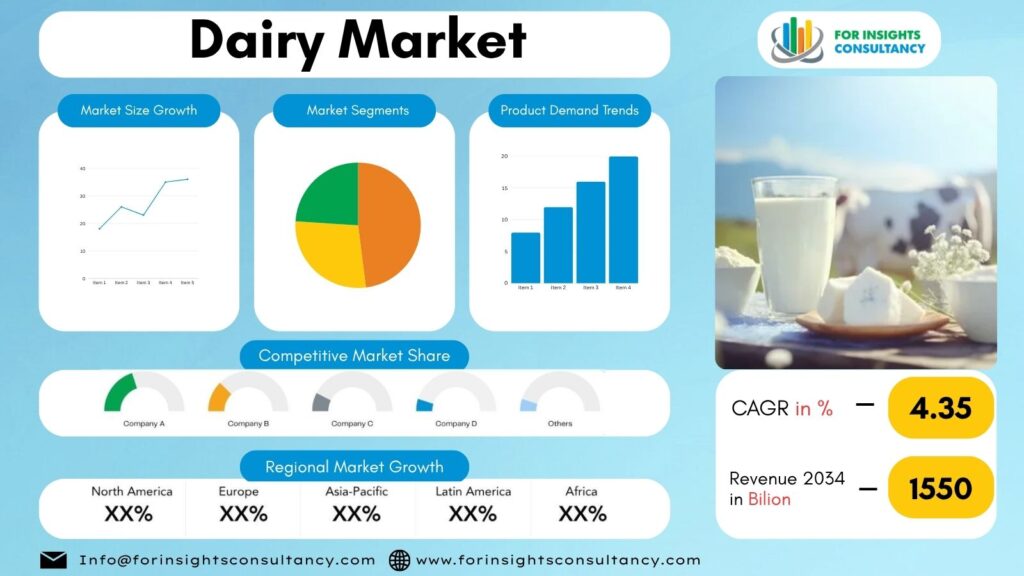
- Market Size (2026): 1.08 Trillion
- Forecast (2034): 1.55 Trillion
- CAGR (2026–2034): 4.35%
- Base Year: 2025
- Largest Segment (2026): Liquid Milk — ~58.83% share.
- Leading Region (2026): Asia-Pacific —~41.06% share
Dairy Market Overview (2026)
The worldwide dairy market is forecasted to be worth in the region of $1.0 – 1.15 trillion dollars in 2026, and most research companies anticipate growth in the region of $1.5 – 1.9 trillion dollars for mid-2030s with a CAGR of 4-5.5%, with the estimates varying largely depending on the scope (“dairy products” for some research vs. “dairy foods” for others). Drivers for the growth are increased protein demand in the world, growing nutritional awareness, urbanization, and development of organized dairy processing infrastructure, with FAO stating that more than 80% of the world’s population consume dairy products of any kind. The milk is the leading product line in terms of revenue (occupying around 60%+ share in almost all segments), while yogurt and added-value products like Greek yogurt and probiotics fortified dairy are always mentioned as the fastest growing sub-segments due to their gut health claims and ability to charge premium prices (around 18-25% over regular dairy products).
Asia-Pacific leads regionally, accounting for an approximate 36 to 47% market share through different sources due to high population size, growing income and cooperative-led liquid milk delivery system of India in the region, while North America is considered the fastest-growing region by percent owing to their stable margin programs and growing capacity of value-added processing. Supermarket/hypermarket continues to be the main distribution channel (accounting for approximately 60% of the market share), but online/e-commerce distribution has been noted to grow faster than other channels owing to the direct-to-consumer dairy brands. Some of the major companies that are shaping up the industry dynamics include Nestle, Danone, Fonterra, Lactalis, Dairy Farmers of America and Arla Foods. The key trends for the current year are related to sustainable dairy farming, lactose-free and specialty product development, and stringent regulations such as EU Green Deal on methane emission standards.
Request a Free Sample Copy: https://www.forinsightsconsultancy.com/reports/request-sample-dairy-market
Dairy Market Dynamics
Growth Driver 2026
Increasing world population and urbanization – Increased demand for dairy as an essential component of diet due to growing urban population especially in Asia-Pacific, Africa, and Latin America.
Increasing awareness of health and nutrition – Increased consumer concern about health benefits like protein content, bone strength, and calcium/vitamin D in dairy products.
Increasing demand for functional/probiotic dairy products – Increased consumer concern about health aspects such as gut health, immune system strength, etc. has increased the popularity of fermented dairy products such as yogurt and kefir.
Advancements in technology related to dairy farms – Automation in milk collection systems, improved feeding techniques, and digitization of dairy farms have made yields more efficient.
Trends 2026
Functional & Fortified Dairy on the Rise
With consumers increasingly prioritizing gut health, metabolic balance and immunity, probiotic-fortified dairy and functional milk have seen increased demand, with branded milk commanding a 18-25% premium over ordinary products.
Yogurt & Other Value-added Products Leading Milk Sales Growth
Despite being the largest revenue segment, milk is being outpaced by yoghurt and specialty dairy products such as Greek yoghurt and protein-fortified dairy in terms of sales growth, which can be attributed to the consumers’ move towards protein-enriched products.
On-trad Channel Growth
Consumption of dairy via the food service or on-trade channels is growing at a faster rate than consumption via retail due to an increase in culinary trends involving the use of dairy; cheese-filled menus (pizza, cheese boards), increase in milk consumption through the coffee culture and increased consumption of paneer, lassi and milk-based desserts in India.
Regulatory Pressures for Sustainable Farming Practices
Tighter regulations on methane emissions under the EU Green Deal are causing processors to track their methane emissions per farm, hence increasing investments in sustainable farming practices across the industry.
Dairy Market Top Companies Covered In this Report are
- Nestlé S.A.
- Danone S.A.
- Lactalis Group
- Royal FrieslandCampina N.V.
- Fonterra Co-operative Group Limited
- Dairy Farmers of America, Inc.
- Arla Foods amba
- Saputo Inc.
- Grupo Lala, S.A.B. de C.V.
- Meiji Holdings Co., Ltd.
- Megmilk Snow Brand Co., Ltd.
- Amul (Gujarat Cooperative Milk Marketing Federation)
- Unilever (dairy-adjacent via spreads/ice cream categories)
- General Mills, Inc. (via Yoplait)
- China Mengniu Dairy Company Limited
- Inner Mongolia Yili Industrial Group Co., Ltd
Dairy Market Company news 2026
Fonterra (New Zealand)
Fonterra (New Zealand) agreed to sell its global consumer and associated businesses to Lactalis, a deal expected to complete in 2026 and drop Fonterra from 7th to roughly 10th place globally.
FrieslandCampina and Milcobel
FrieslandCampina and Milcobel announced a merger that could create a top competitor in Northern Europe.
Dairy Market Segments
By Category/Product Type
- Milk – biggest sales revenue stream (~60–62% market share from all sources)
- Cheese – second largest product stream; fueled by high demand in food service/on-premise channels
- (Yogurt) – fastest growing product segment, thanks to its protein-enriched, functional/probiotic benefits
- Butter – another stable product line that is used in retail/foodservice cooking/baking operations
- Cream – another small segment; mainly driven by foodservice/culinary applications
- Others (dairy-based desserts, powder milk, whey) – niche products growing in popularity; powder milk especially in emerging markets
By Distribution Channel
- Supermarkets & Hypermarkets — dominant channel (~60.5% share), offering convenience, variety, and competitive pricing
- Online/E-commerce — fastest-growing channel, driven by expanding direct-to-consumer dairy brands and cold-chain delivery improvements
- On-Trade (Foodservice) — fastest-growing channel by CAGR (~6.9%), fueled by cheese-heavy menu trends and coffee culture’s rising milk consumption
- Convenience Stores — relevant for single-serve, on-the-go dairy purchases
- Specialty Stores — key channel for premium, artisanal, or lactose-free dairy products
By Processing Type
- Pasteurized & UHT Milk — dominant retail format, favored for extended shelf life and broader distribution reach
- Fresh/Raw Dairy — smaller, localized segment tied to traditional consumption patterns in certain regions
- Fortified/Functional Dairy — rapidly growing segment, incorporating probiotics and added nutrients for health-focused positioning
By End User
- Household/Retail Consumption — largest end-user segment, driven by daily dietary staples
- Foodservice/HoReCa — growing segment, tied to rising dairy-integrated culinary experiences in restaurants and cafés
- Industrial/Food Processing — significant B2B segment, using dairy as an ingredient in packaged foods, bakery, and confectionery
Dairy Market Regional Insights
North America
Market Share (2026): ~16-17%
Leading Brands: Dairy Farmers of America, Saputo, Nestle (local operations), General Mills (Yoplait)
Trends in Demand: Saputo recorded the highest revenue growth rate of 8.4% amongst leading global companies based on the recent ranking, owing to increased efficiency in production; Dairy Farmers of America is one of the leading global companies despite experiencing domestic pricing instability; steady demand for lactose-free and functional dairy products is guiding innovation in the sector.
Asia Pacific
Market Share (2026): ~41.06%
Top brands: Inner Mongolia Yili Industrial Group, China Mengniu Dairy, Amul (India), Meiji Holdings, Megmilk Snow Brand
Trends among Consumers: The biggest and most populous dairy consumption base in the world; nevertheless, according to Rabobank’s forecast in 2026, at present China is experiencing an overproduction of liquid dairy and ice cream, even though milk powder is still growing in the area; the Amul from India is continuing its cooperative-based expansion due to increasing demand in both rural and urban regions; rising income of the middle class in Southeast Asia leads to increased acceptance of fortified dairy products.
Europe
Market Share (2026): 26-27%
Leading Brands: Lactalis, Danone, Arla Foods, Royal FrieslandCampina, Savencia
Consumption Trends: As defined by Rabobank as “at the heart of the industry” with 11 of the Top 20 global dairy firms based in this region; going through massive consolidation in 2026 (merger between FrieslandCampina and Milcobel and negotiations of Arla and DMK mergers) due to robust currencies and well-established cold chains; strong emphasis on functional/probiotic dairy innovation and PDO/PGI-protected cheese categories.
Middle East & Africa
Market Share (2026): ~6–7%
Top Brands: Dairy brands from regional and international markets; very few prominent multinational brands as compared to other regions
Consumption Trends: Increase mainly in rich Gulf nations (UAE, Saudi Arabia) due to development of modern retail facilities; growth in Africa is still in its initial stages due to increasing cold chain facilities and nutrition-based government policies.
Latin America
Market Share (2026): ~9-10%
Leading Brands: Grupo Lala (Mexico), regional cooperatives/processors
Consumption Trends: Driven by higher rates of urbanization and disposable income; Grupo Lala continues to be a leading regional brand, especially in Mexico and Central America; rising consumption of value-added dairy (flavored milk/yogurt beverages).
Frequently Asked Questions
What’s the size of the global Dairy industry right now?
The global market for Dairy has a valuation of about $ 1.08 Trillion in 2026 and will reach $1.55 Trillion in 2034, growing at a 4.35%.
What is driving the growth of the global dairy market?
Rising global population, urbanization, health-conscious demand for protein and functional dairy, and expanding cold-chain infrastructure in emerging markets are the key growth drivers.
How is the rise of plant-based alternatives impacting dairy market revenues?
Plant-based alternatives are pressuring traditional dairy segments like milk and ice cream in mature markets (prompting divestments like Unilever’s ice cream spin-off), but overall dairy revenues continue growing steadily as demand in emerging markets outpaces the shift.
Which regional markets present the highest growth opportunities for dairy exporters?
Asia-Pacific (particularly India and Southeast Asia) and parts of Africa and Latin America present the highest growth opportunities for dairy exporters, driven by rising incomes, urbanization, and expanding modern retail and cold-chain infrastructure.
Which region dominates the dairy market?
Asia-Pacific dominates the dairy market, holding roughly a ~41.06% share in 2025–2026.
Which segment is expected to hold the largest share in the dairy market?
By product type, Liquid Milk is expected to hold the largest share at approximately 58.81%.
Key target audiences for the Dairy market include:
- Consumers: Households/individual consumers, health-conscious buyers seeking protein and functional nutrition, parents purchasing infant nutrition products, aging populations focused on bone/calcium health
- Manufacturers & processors: Global dairy conglomerates, regional processors, and cooperatives (e.g., Amul-style farmer collectives)
- Foodservice & food manufacturing: Restaurants, bakeries, and food/beverage manufacturers using dairy as a core ingredient
- Retail & distribution channels: Supermarkets/hypermarkets, convenience stores, specialty stores, and online grocery platforms
- Farmers & dairy producers: Cattle, buffalo, goat, sheep, and camel dairy farmers supplying raw milk to processors
- Investors & institutional stakeholders: PE/VC firms, M&A advisors, and institutional investors tracking the ongoing 2026 consolidation wave (mergers, divestments, acquisitions)
- Ingredient & equipment suppliers: Dairy processing equipment manufacturers, packaging suppliers, and cold-chain logistics providers
- Regulatory & health bodies: Food safety authorities overseeing quality standards, labeling, and recall management (especially relevant given 2026 contamination incidents)
- Nutraceutical & supplement companies: Firms using whey protein, lactose powder, and other dairy derivatives in supplement formulations
- Market research analysts & consultants: Firms and buyers tracking market sizing, M&A activity, and competitive landscape shifts in this rapidly consolidating industry
Customization Available
This report can be tailored to meet specific client requirements. The following customization options are available upon request:
Regional & Country-Level Customization
- Detailed analysis for any specific country not covered in the standard report (e.g., Indonesia, Mongolia, Mozambique)
- Deeper sub-regional breakdowns within Asia-Pacific, North America, Europe, or Middle East & Africa
Company-Specific Analysis
- Detailed profiling of additional companies beyond those covered (financials, SWOT, product portfolio, recent developments)
- Competitive benchmarking of up to 5 additional company profiles
Segment-Level Customization
- Additional breakdown by any specific grade, application, or end-use segment not covered in the base report
- Historical data extension beyond the standard base year.
Any Requirement Contact Us: https://www.forinsightsconsultancy.com/contact-us
Related Market Reports
Dairy Processing Equipment Market Size, Shares and CAGR by 2034
Dairy Alternatives Market Report: Size, Share & Analysis 2034
Dairy Desserts Market Insights 2026: Trends & Forecast 2034
Dairy Products Market Size, Segments, Growth, 2034
Table of Contents
For TOC Contact us: https://forinsightsconsultancy.com/contact-us/