

Pages: 300 | 21 October 2026 Formats | PDF | Category: Information Technology | Delivery: 24 to 72 Hours
Game Finance(GameFi) Market Size Statistics
Market Size (2026): USD 2.9 Billion
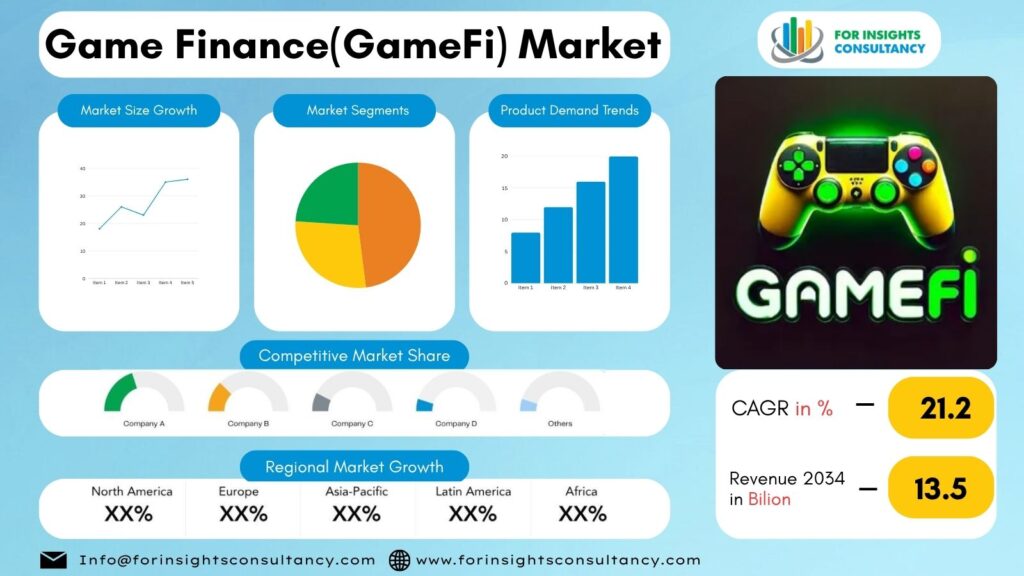
Forecast (2034): USD 13.5 Billion
CAGR (2026–2034): 21.2%
Base Year: Approximately USD 2.4 Billion
Leading Segment (2026): Play-to-Earn (P2E) Games, estimated leading category
Leading Region (2026): Asia-Pacific, estimated leading region, with an indicative 40–45% share
Core Trends: Transition toward sustainable blockchain gaming economies, combining engaging gameplay, player-owned digital assets, token utility, and NFT integration beyond speculative play-to-earn rewards.
Game Finance(GameFi) Market Definition
GameFi is defined as the ecosystem of blockchain-enabled gaming platforms and apps which combine gaming with decentralized finance (DeFi), cryptocurrencies, non-fungible tokens (NFTs), and ownership of digital assets. In game finance players can gain, trade, buy, and exchange their digital assets, and in addition, earn tokens for participating in certain activities within some games. Some examples of game finance include blockchain-enabled gaming platforms, play-to-earn games, games based on non-fungible tokens (NFTs), gaming tokens, and marketplaces for digital assets.
Game Finance(GameFi) Market Overview 2026
The global market of Game Finance (GameFi) is developing as blockchain technology, cryptocurrency, non-fungible tokens (NFTs), and decentralized finance are becoming an integral part of gaming industry. GameFi represents a combination of gaming and blockchain-based economies, which enables users to buy, trade, purchase or earn digital assets through gaming. In 2026, GameFi includes P2E games, NFT-based gaming platforms, blockchain gaming infrastructures, gaming tokens, digital assets marketplaces, and decentralized gaming ecosystems. In contrast to traditional games, in which in-game assets are owned by game publishers, GameFi platforms can allow players to have verifiable ownership of their supported digital assets.
Market development of GameFi in 2026 is driven by growing use of Web3 technology, interests in digital ownership and the emergence of new business models for game developers and publishers. Blockchain-based games are experimenting with token rewards, NFT collectibles, digital lands, player marketplaces, and community economies. Still, successful platforms are becoming to require enjoyable gameplay, user retention, security and sustainability of in-game economies more than just token rewards. Such aspects are crucial in understanding if GameFi will be able to attract mass audience of gamers, in addition to crypto and blockchain fans.
The primary segments of the GameFi market are play-to-earn games, NFTs-based games, role-playing games enabled by blockchain, strategy games, metaverse gaming experience, and gaming assets marketplaces. The revenue generation possibilities depend on the business model and may include the money earned through purchases in-game, NFT transactions, marketplaces’ commissions, token-related transactions, subscription fees, and other platform services. Game developers, blockchain providers, token platforms, NFT marketplaces, and gaming communities form the ecosystem of GameFi as a whole. The differentiation of the gaming revenues and the value of traded digital tokens or assets is important when evaluating the real size of the GameFi market.
In terms of regions, North America enjoys the development of blockchain technologies, investments in gaming, advanced tech companies and digital asset market infrastructure. There are a lot of opportunities in Asia-Pacific due to the huge gaming audience, popularity of mobile gaming and developing technology ecosystem. Europe makes its contribution in game development, digital innovations and regulation development, while the other emerging markets offer their potential for mobile blockchain gaming.
Request a Free Sample Copy: https://forinsightsconsultancy.com/reports/request-sample-game-financegamefi-market (Sample Include key points such as 2026 market size, 2034 forecast, CAGR, leading product segment, fastest-growing segment, dominant region, major companies, trends, growth drivers, challenges, and opportunities.)
Trends 2026
Shift Toward Sustainable Play-to-Earn Models
In 2026, GameFi developers are moving beyond reward-driven gaming toward sustainable play-to-earn ecosystems that balance player incentives, engaging gameplay, and long-term economic stability. More balanced token distribution and in-game reward mechanisms are becoming important for player retention.
Integration of NFTs and Digital Asset Ownership
Non-fungible tokens (NFTs) enable players to own supported in-game assets, including characters, collectibles, equipment, and virtual land. Game developers are exploring ways to give these assets practical gameplay utility and trading opportunities through blockchain-enabled marketplaces.
Growth of Web3 Gaming Platforms
Web3 gaming platforms are integrating blockchain wallets, digital currencies, decentralized applications, and community participation into gaming experiences. Simplified registration and wallet access are emerging as important priorities for attracting users beyond established cryptocurrency communities.
Improved Gameplay and Mainstream Adoption
GameFi projects are increasingly emphasizing graphics, storytelling, multiplayer features, and competitive gameplay instead of relying primarily on token rewards. Delivering an enjoyable gaming experience is essential to improving user engagement and expanding the potential player base.
Game Finance(GameFi) Market Growth Drivers 2026
Digital ownership through NFTs (primary driver)
One summary calls NFT-based digital ownership the most powerful structural driver for sustained blockchain gaming adoption. A 2026 trend piece says gaming NFTs now capture 38% of global NFT transactions, and weekly NFT gaming sales surged over 30% to $85 million in early 2026. Treat these as directional, since each rests on a single source.
A shift from play-to-earn to play-to-own
The model is changing from short-term speculative “play-to-earn” expansion to ecosystem value accumulation via “play-to-own.” The earlier model declined because of unsustainable tokenomics where continuous user inflow was required to maintain rewards. Top 2026 titles emphasize sustainable tokenomics, multi-platform play, and real player communities.
Mainstream platform access
Platform barriers are falling. Epic Games Store now accepts blockchain games, and Epic partnered with Polygon to integrate NFT support across Fortnite and Unreal Engine. One article adds that Microsoft is exploring NFT integration for Xbox and Sony has filed blockchain gaming patents, though I’d treat those as signals, not products.
Mobile-first and social distribution
Growth is moving to phones and messaging apps. One trend article cites Telegram and mobile-first crypto gaming growth and the expansion of GameFi ecosystems on TON, Ethereum L2s and Solana. Another expects a surge in mobile-first blockchain games designed for casual players.
Top Companies Covered in the Game Finance(GameFi) Market are
- Sky Mavis
- Animoca Brands
- Immutable
- Dapper Labs
- Gala Games
Game Finance(GameFi) Market Company news 2026
Animoca Brands
Animoca announced on November 3, 2025 a route to the Nasdaq through a reverse merger, and the combined company would carry an estimated valuation of around $2.4 billion at listing. A May 2026 roundup says it extended the exclusivity period for its reverse Nasdaq listing process.
Sky Mavis
one report says Sky Mavis rebuilt its rewards model in 2026. The weekly roundup adds that the SLP token will stop being given away as a reward in Axie Infinity: Origins, due to the level of bot extraction, and that Sky Mavis is working on Ronin v2 tokenomics and launched the first playtest for its MMORPG Axie Infinity: Atia’s Legacy.
Game Finance(GameFi) Market Segments
By Game Model
- Play-to-earn (P2E): Players earn tokens or NFTs through gameplay. It is the largest model, though many early versions struggled with unsustainable rewards.
- Play-to-own: Players hold and trade in-game assets as NFTs with on-chain ownership, a model gaining ground as tokenomics mature.
By Component
- Games and platforms: The titles, virtual worlds and launchers where players spend time and money.
- NFTs and digital assets: Characters, land, items and collectibles that players own and trade.
By Blockchain Type
- Public blockchains: Open networks such as Ethereum and its layer-2 chains, Solana and TON, used by most GameFi projects.
- Gaming-specific chains and rollups: Networks built for games, which offer lower fees and faster play.
By Game Genre
- Collectible and battle games: Creature and card games built around owning and trading assets.
- Metaverse and virtual worlds: User-built spaces where players buy land and create experiences.
Game Finance(GameFi) Market Regional Insights 2026
North America:
North America has the strongest base of investors and studios. North America is also the most vulnerable to regulatory challenges: the United States does not have federal rules.
Europe:
There are clear rules for Europe. The MiCA rule from the EU has brought clarity to the classification of NFTs.
Asia-Pacific:
The Asia-Pacific region has the highest player base. According to one report, it makes up roughly 55% of the player base of the overall gaming industry globally, with the companies such as Sky Mavis, Animoca, Wemade and Netmarble.
Latin America & Middle East & Africa
Latin America and Middle East & Africa are relatively smaller regions; however, there is an article that talks about the earning opportunities in developing countries such as the Philippines and Venezuela, while another article says that South Africa and United Arab Emirates are exploring blockchain technology in games.
Frequently Asked Questions
How big is the GameFi market in 2026?
The market is valued at about USD 2.9 billion in 2026, up from approximately USD 2.4 billion in the 2025 base year.
What is the GameFi market forecast for 2034?
It is projected to reach USD 13.5 billion by 2034, more than four times its 2026 size.
What is the CAGR of the GameFi market?
The market is expected to grow at a 21.2% CAGR from 2026 to 2034.
What is driving GameFi market growth?
Wider adoption of blockchain games, player ownership of digital assets, token utility inside game economies, mobile gaming growth and rising developer and investor interest. Growth is moderated by token volatility, regulation and security risk.
Why do published GameFi market sizes differ?
Scope varies by source. Some count only in-game token and NFT revenue, others add wallets, marketplaces and infrastructure, and some mix in enterprise gamification. This report covers blockchain-based games that use tokens and NFTs for in-game economies and rewards.
What’s Included in This Report — Game Finance(GameFi) Market
This report provides a comprehensive analysis of the Game Finance(GameFi) Market, covering the following:
- Market Size and Forecast: Global values for 2025–2034, including USD 2.9 billion in 2026 and USD 13.5 billion by 2034 at a 21.2% CAGR.
- Market Definition and Scope: Clear boundaries for blockchain games that use tokens and NFTs, and what is excluded (for example, enterprise gamification software).
- Segmentation Analysis: Breakdown by business model (play-to-earn, free-to-play, hybrid), technology (NFT, cryptocurrency), blockchain, platform, game genre and region.
- Regional Insights: Asia-Pacific, North America, Europe and emerging markets, with shares, growth rates and country highlights.
- Core Trends and Growth Drivers: Sustainable game economies, player-owned assets, token utility, NFT integration, mobile-first design and cross-chain interoperability.
- Competitive Landscape: Profiles of leading companies such as Sky Mavis, Immutable, Animoca Brands, Gala Games and The Sandbox, with strategies and recent developments.
- Company News 2026: Funding rounds, partnerships, launches and platform changes.
- Regulatory Overview: Rules on tokens, NFTs, gambling and consumer protection by region.
- Challenges and Risks: Token volatility, security breaches, unsustainable reward models and player retention.
- Opportunity Analysis: Fast-growing segments and regions for investors, studios and platform providers.
Why Buy This Research Report?
- Clear Numbers and Scope: A defined boundary and a USD 2.9B (2026) to USD 13.5B (2034) outlook at 21.2% CAGR remove the confusion caused by widely differing published estimates.
- Spot High-Growth Opportunities: Identifies the segments and regions driving growth, including play-to-earn games and Asia-Pacific’s 40–45% share.
- Understand the Shift in Business Models: Shows how the market is moving from speculative play-to-earn toward sustainable economies built on gameplay, player-owned assets and token utility.
- Benchmark the Competition: Profiles of leading studios and platforms and their 2026 moves help you find rivals, partners and acquisition targets.
- Plan Around Regulation: Explains token, NFT and gambling rules by region so you can time launches and market entry.
- Guide Technology Decisions: Helps studios and brands choose blockchains, wallets and platforms.
- Reduce Risk: Highlights token volatility, security and retention challenges before you commit capital.
- Save Research Time: Brings sizing, trends, segments, regions and company news into one decision-ready report.
Buy This Report Now — https://forinsightsconsultancy.com/buy-now-game-financegamefi-market (Access In-Depth Analysis, Forecasts & Company Profiles)
Related Market Reports of Information Technology Industry
Cryptocurrency and Blockchain Market Size
Table of Contents
- Market Overview
- Market Definition
- Market Segmentation
- Key Trends and Developments
- Global Market Size and Forecast
- Historical Market Size (by Year)
- Current Market Size
- Forecasted Market Size (by Year)
- Growth Rate (CAGR)
- Market Segmentation by Type
- Types of GameFi Models (e.g., Play-to-Earn, Play-to-Own, Metaverse Games, NFT Gaming)
- Market Share by Type
- Growth Rate by Type
- Market Segmentation by Platform
- Platforms for GameFi (e.g., PC, Mobile, Console, VR/AR)
- Market Share by Platform
- Growth Rate by Platform
- Market Segmentation by Game Genre
- Game Genres in GameFi (e.g., RPG, Strategy, Action, Simulation)
- Market Share by Genre
- Growth Rate by Genre
- Market Segmentation by Revenue Model
- Revenue Models (e.g., In-Game Purchases, Subscriptions, Advertising, NFTs)
- Market Share by Revenue Model
- Growth Rate by Revenue Model
- Geographical Market Analysis
- Market Size and Growth by Region (e.g., North America, Europe, Asia-Pacific, Latin America, Middle East & Africa)
- Regional Market Share
- Regional Growth Trends
- Competitive Landscape
- Key Players in the Market
- Market Share of Leading Companies
- Company Profiles (including revenue, product offerings, and strategic initiatives)
- Pricing Analysis
- Average Pricing Models by Region
- Price Trends
- Factors Influencing Pricing
- Investment and Funding Analysis
- Major Investments and Funding Rounds
- Key Investors and Funding Trends
- Investment Opportunities
- Regulatory and Standards Overview
- Relevant Regulations and Standards
- Impact of Regulations on the Market
- Technological Trends
- Innovations in GameFi Technology
- Technological Advancements and Their Impact on the Market
- Consumer Insights
- Player Preferences and Behavior
- Buying Patterns
- Market Demand Drivers
- SWOT Analysis
- Strengths, Weaknesses, Opportunities, and Threats in the Market
- Challenges and Barriers to Entry
- Major Market Challenges
- Barriers for New Entrants
- Market Dynamics
- Market Drivers
- Market Restraints
- Market Opportunities
- Market Threats
- Historical and Projected Market Data
- Historical Market Data (by Year)
- Projected Market Data (by Year)
- Key Market Trends and Innovations
- Emerging Trends in GameFi
- Innovations Shaping the Market
Select PDF License
Single User: $1999
Multiple Users: $3999
Corporate Users: $4999